How to choose an electric lunch box
The first decision is power source, and it maps directly to where you eat. Plug-in models that run on a standard 110V outlet are the cheapest and lightest option for office workers: set your meal down at your desk mid-morning and it slowly warms through by lunch. Drivers and field workers should look for 12V/24V vehicle compatibility or battery-powered models instead. Cordless battery models are the newest category — a rechargeable pack, often 20,000mAh or more, heats food with no outlet at all. That is liberating on construction sites, night shifts, and long commutes, but the battery makes them noticeably heavier, and you have to remember to charge them.
Electric lunch boxes are slow by design — think of them as miniature ovens rather than microwaves. Most take 30 to 60 minutes to bring a refrigerated meal to serving temperature, and that is a feature, not a flaw: slow, even conduction heat does not dry out food or create cold spots the way a microwave does. Wattage roughly tracks speed — 80 to 100W models heat faster than 40 to 60W ones. If your lunch break is short, start warming earlier, or choose a model with a keep-warm mode you can switch on when you arrive.
The container your food actually touches matters more than the marketing. Food-grade 304 stainless steel containers are the gold standard: they do not stain, do not retain odors, and survive hundreds of wash cycles. Plastic inner containers are lighter and cheaper but can warp over time and absorb curry or tomato stains. Glass containers, included with some larger warmers, reheat beautifully and go straight to the table, though they add weight. Whatever you choose, look for a tight, leak-resistant lid — a warmer that leaks soup into your bag is worse than no warmer at all.
Capacity is measured in liters, and the sweet spot for most adults is 1 to 1.5 liters — roughly a generous meal. Smaller 0.7 to 0.9L models suit light eaters but leave no room for sides. Larger 2L-plus or casserole-size warmers are built for meal preppers who eat big or share. Measure your bag too: cordless models with dual containers can be as bulky as a small cooler, and a warmer that does not fit your daily carry will not get used.
Cleaning separates the models you will use daily from the ones that gather dust. Removable inner containers that are dishwasher safe are non-negotiable for daily use; wipe-clean-only bodies are fine, since food should never touch them. On safety, look for overheat protection and food-safe materials (BPA-free plastics, 304 stainless). And remember the food-safety clock: keep hot food at or above 140°F (60°C), and do not let a cooked meal sit in the warm zone between 40°F and 140°F for more than two hours total. Most decent warmers with a keep-warm mode handle this easily, but it is worth knowing the rule.
- Power source: 110V for the desk, 12V/24V for car and truck, or battery for true portability — match it to where you actually eat.
- Heating style: slow conduction-heat totes are gentlest on delicate food; direct-heat boxes run a bit faster.
- Container material: 304 stainless steel or glass over thin plastic for durability and easy cleaning.
- Capacity: 1–1.5L for a standard adult lunch; check that it fits your bag.
- Included extras: cutlery, an insulated carry bag, and extra power cables add real everyday value.
- Safety features: overheat protection, BPA-free materials, and a leak-resistant lid.
The top picks
Affiliate disclosure: As an Amazon Associate I earn from qualifying purchases. Read our full disclosure.
1. HotLogic 16801169-RD Food Warming Tote Lunch Bag Plus 120V
The desk classic
HotLogic invented this category, and this is the model office workers keep recommending year after year. It is a soft insulated tote with a built-in low-and-slow heating element: drop in your meal, plug it into a 110V outlet, and walk away. There are no buttons, timers, or settings — gentle conduction heat brings food to serving temperature over an hour or two and holds it there without overcooking or drying. Reviewers use it for everything from last night's leftovers to frozen boxed meals, and the consistent praise is for how little there is to think about: plug in, forget, eat hot.
Pros: Genuinely set-and-forget — no buttons, timers, or stirring; gentle heat that never dries food out; lightweight tote is easy to carry to the office.
Cons: 120V only, so it is home- and office-bound; slow by design — not for ten-minute lunches; tote styling is practical rather than pretty.
Check current price on Amazon →2. HOTLOGIC Max Large Portable Electric Food Heater with Glass Container
The big-batch warmer
When a standard lunch box is too small, the HotLogic Max steps up. This large 120V warmer fits 9x13 casserole-style containers and ships with a glassware container included, so it doubles as a mini warming oven for potlucks, family dinners, and meal-prep Sundays. Like the smaller tote, it uses slow conduction heat with no buttons or monitoring — plug it in, go about your day, and come back to hot food. It is compatible with most flat-bottom, sealable containers (glass, metal, even foil trays), and reviewers who batch-cook say it is the one appliance that gets daily use all winter.
Pros: Fits large containers up to 9x13 inches; glass container included and goes straight to the table; can slowly cook raw dishes, not just reheat.
Cons: Bulky — check your counter and storage space first; 120V only, not for vehicles; heavier than tote-style warmers.
Check current price on Amazon →3. Heyfavor 80W 3-in-1 Electric Lunch Box (12V/24V/110V)
The car-and-office all-rounder
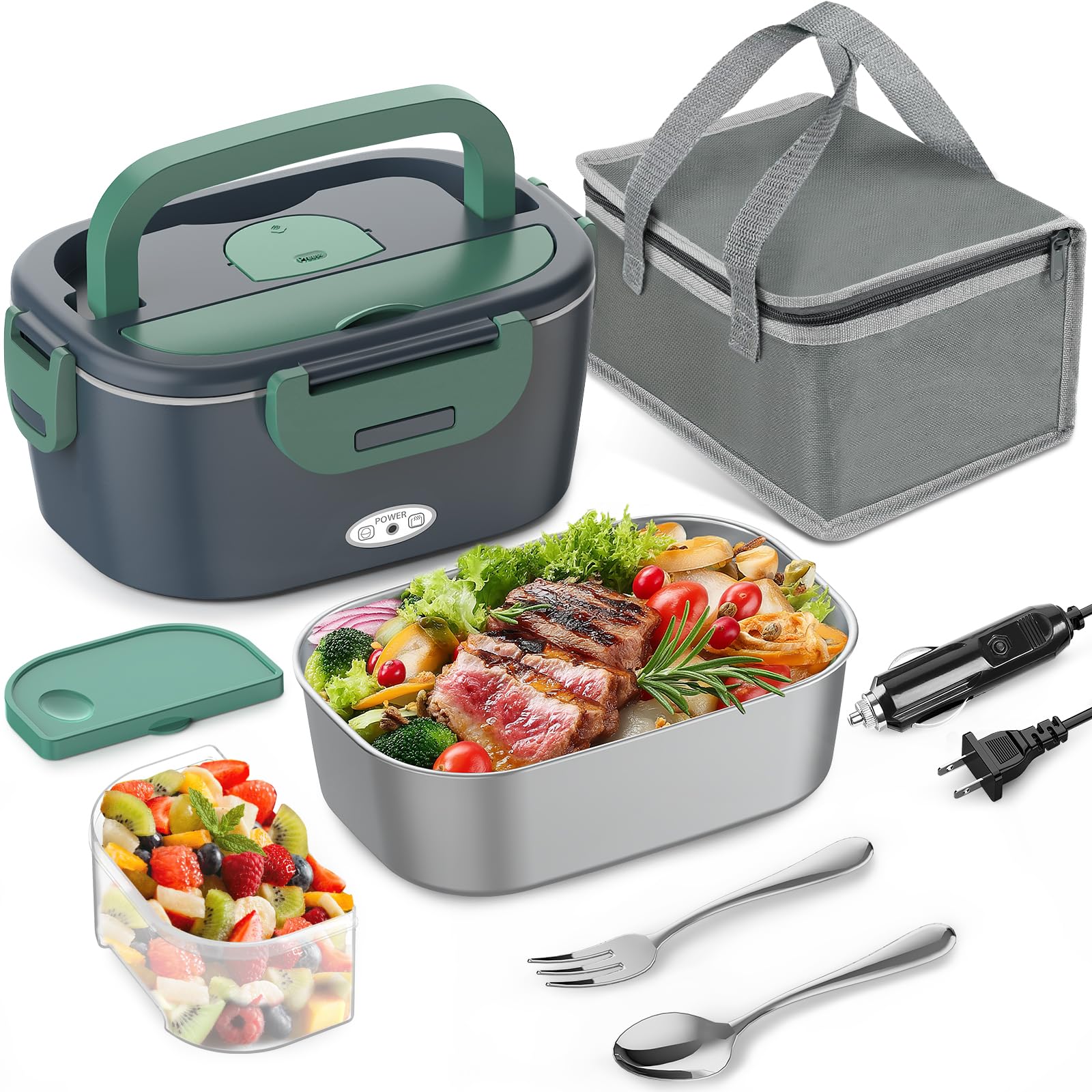
If your lunch happens in more than one place, this is the model to look at. The Heyfavor 3-in-1 runs on 110V wall power, 12V car sockets, and 24V truck sockets — cables for all three are included in the box — so the same warmer works at the office and in the cab. The 1.5L food-grade stainless container is a proper adult portion, and it ships with a fork, spoon, and insulated carry bag, so there is nothing else to buy. At 80W it heats noticeably faster than low-wattage totes, typically bringing a refrigerated meal up to temperature in about 30 to 40 minutes.
Pros: Three power cables included (110V/12V/24V); 1.5L stainless container plus cutlery and bag in the box; 80W heats faster than most totes.
Cons: One container size with no expansion option; plastic outer shell needs wipe-cleaning; keep track of which cable lives where.
Check current price on Amazon →4. Cordless Battery-Powered Electric Heated Lunch Box
The cordless freedom
No outlet? No problem. This cordless warmer packs a 24,000mAh rechargeable battery and 100W of heating power, warming two 1.2L stainless containers to up to 220°F with no plug in sight. The standout feature is scheduled heating: set it up to 12 hours ahead and your meal starts warming automatically before your break. Four heating modes cover chilled food, room-temperature meals, custom time-and-temperature programs, and a keep-warm mode that holds food at a safe 149°F. It ships with a dual-chamber insulated bag, stainless cutlery, and a fruit box. At over 5 pounds it is the heavyweight of this guide, but for construction sites, night shifts, and anywhere outlets are scarce, it is in a class of its own.
Pros: Truly cordless — heats anywhere with no outlet; scheduled heating up to 12 hours ahead; two 1.2L containers plus a safe keep-warm mode.
Cons: Heavy at over 5 pounds; the battery needs recharging after heavy use; the bulkiest option in this guide.
Check current price on Amazon →Affiliate disclosure: As an Amazon Associate I earn from qualifying purchases. Read our full disclosure.